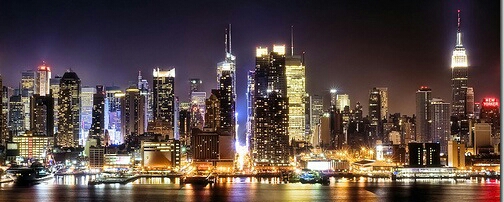

“Stand away from the closing doors, please”
That’s right, this phrase is heard by about 4.5 million people who ride the New York subway system every day. Sometimes it is a recorded message and sometimes it comes from the conductor who sits mid-train and controls the train doors. I wouldn’t like to guess how many times it is repeated but with trains stopping at over 600 stations every few minutes, 24 hours a day on 23 lines, it has to be a lot.
The New York subway system is a remarkable thing. October 27 marked the 108th Anniversary of the decision to construct the “1” line from City Hall in south Manhattan north up Broadway to 145 Street on the Upper West Side – Hamilton Heights today – and into the Bronx. This service was quickly expanded south to Atlantic Avenue in Brooklyn, under the East River
This is our most frequently used line which rumbles under the sidewalks along 7th Avenue and mildly shakes the floors as we sit in the bars and restaurants, or even lie in bed on a quiet Sunday morning. The plaque in the station at 23rd and 7th says it was opened in 1908 and refurbished in 1990. The cement floors, white and green tile and the steel columns supporting the street above are clearly that old.
For those old enough to remember the discussions in Vancouver in the 60s and 70s about mass transit, it is worth noting that the same happened in New York, however, these discussions happened in the 1890s. There was some agreement that the city and surrounding areas should prepare for mass transit but it was not agreed whether this should be elevated – several elevated railways were in operation in the City at the time – or underground. In the inner city, underground obviously won out, however no private company was willing to put up the enormous capital required to build beneath the streets. The City decided to issue rapid transit bonds, outside of its regular bonded debt limit, and build the subways itself. It contracted with the Interborough Rapid Transit Company (which by that time ran the elevated lines in Manhattan) to equip and operate the subways, sharing the profits with the City and guaranteeing a fixed five-cent fare. An early P3.
At the same time the Brooklyn Rapid Transit Company was expanding its holdings in Brooklyn – then a separate city – and wanted to expand into Manhattan. The City entered into contracts with both BRT and IRT and most of the subway system was built during the next 20 years by these competing companies. In the 1930s, the City of New York introduced the Independent Subway System which it owned and operated. The current line up 8th Avenue was the first line it built. In 1940 the three lines were brought together by the City and in 1953 a state created the New York Transit Authority, now part of the Metropolitan Transportation Authority which operates subways, buses, bridges and tunnels to and from Manhattan.
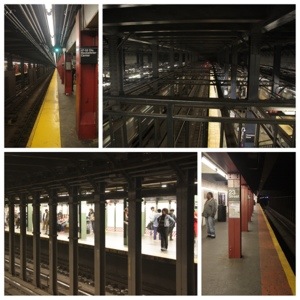 Despite the unification, a distinction between the three systems still exists. The IRT lines (now referred to as A Division) have numbers and BMT/IND (now collectively B Division) lines use letters. There is also a more physical but less obvious difference: Division A cars are narrower than those of Division B by 18 inches and shorter by 9 to 24 feet. For us, the “1” train runs up 7th Avenue, the F, B, D and M lines run up 6th Ave and if we walk over to 8th Ave we can catch the A,B or C lines.
Given the age of the system, it is not surprising that most are a little tattered around the edges. On the other hand much of the original tile work from 80 or more years ago is beautiful, protected by the elements. They bring a timelessness that is appropriate.
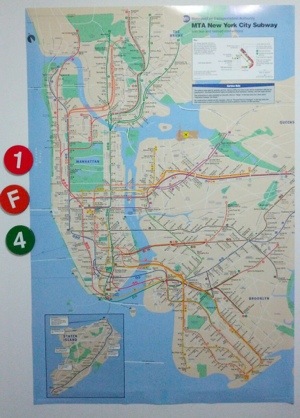 The system seems like a plate of spaghetti when you look at the map but it is a fully integrated system which serves the length of Manhattan, the areas north into the Bronx, north east into Queens and east into Brooklyn. The system carries about 140 million passengers a month; that’s about 4.6 million A DAY! Everyone in New York takes the train, it doesn’t matter if you are coming from the suburbs, travelling uptown or down on business, going out for dinner or the theatre or visiting the touristy places. The locals sit with blank faces, laughing inside I am sure at the tourists scouring their subway maps or trying to find their way on their smartphone app.
We have seen a few “solicitors” on the train, normally raising money for a worthy cause or the occasional “homeless” person trying to raise a buck.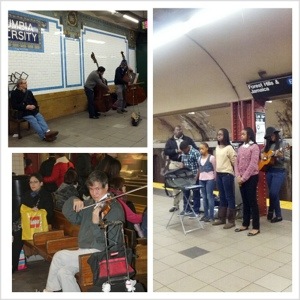 The platforms often have buskers, playing or singing, all with their hats or cases out for donations. Yesterday we had a small Mexican group playing music on the train down to Battery Park.
There are few fancy ground level station entrances, just stairs emerging on the sidewalk above, marked with green and white globe lights. Below ground, many stations are vast caverns with many lines running through them. Even the above ground stations don’t seem out of place – almost as if they are part of the landscape.
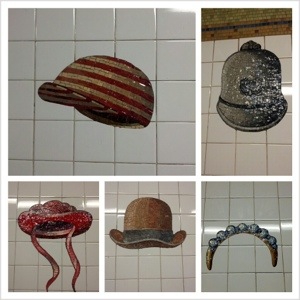
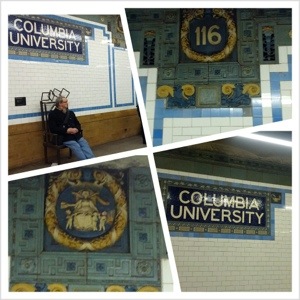
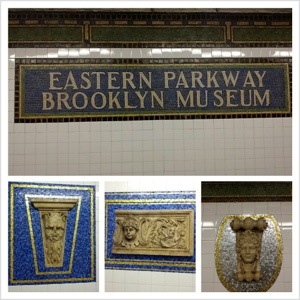 Many stations have some unique tile work that distinguishes them. Dinosaurs and animal mosaics adorn the 81st Street station at the Museum of Natural History; hats of famous New Yorkers adorn the 23 and Broadway station; an Alice and Wonderland mosaic is at 50th and Broadway in the heart of the theatre district; and music and theatrical renderings near Lincoln Centre. There is even an “app” available to track the public art installed on the system.
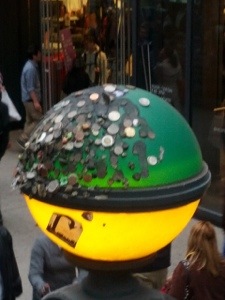 This subway entrance has a unique bit of public art. It is located on 34th Street not far from the Empire State Building at a tour bus stop. The light has been adorned by coins and other collectibles secured by gum by tourists sitting on the upper deck of the bus. Notice the “toonie”?
On the trains themselves, there is the normal advertising you see on all transit systems. In addition there is a transit poster program that produced the graphic at the opening of this blog. We have actually seen all of these characters on the train and one night we saw a gentleman dressed as the Mad Hatter with signature hat, make up and platform shoes.
We use the subway system to go everywhere: Uptown, Downtown, Coney Island, Brooklyn and Queens and the Bronx Zoo. I was asked if I missed the car but I haven’t. The train is so convenient to go anywhere. An MTA sponsored challenge resulted in more than 20 “apps” that chart your walk to the appropriate subway station from wherever you are, the trains and transfers you should take and the walk to your destination. It is actually a lot of fun to pop up from a station and see what is in the area. The best part is we are now being regularly asked for directions, definitive proof we have become New Yorkers.
 Penny & Ken
 Casa New York