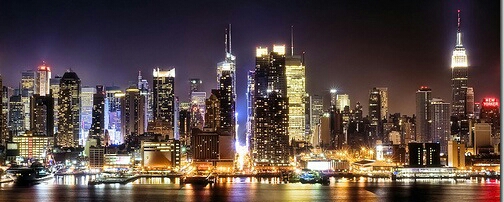
The really fun thing about New York – and Boston, as we wrote in our Boston Blogs – is that wherever you go there is so much history. There are famous places, and reminders of names and events that almost everyone of us has some awareness of. The other interesting thing is the transitions that New York neighbourhoods have gone through over the last 250 years and how those changes are reflected there today. The East Village may be the most transitional of those neighbourhoods.
Over the last two days, we spent several hours over two days wondering through the East Village and were amazed at its story. The East Village is located on the east side of Manhattan from about 14th Street down to Houston and from Broadway/Lafayette to the East River. The East Village references its location immediately east of Greenwich Village.
The East Village also has subareas. The blocks Immediately east of Broadway used to be known as the Bowery (if you don’t remember the Bowery read on). Since the early 1970s it has come to be known as NoHo, for “North of Houston.” Further east, beyond 1st Ave, is Alphabet City, so named because of the series of avenues named from the alphabet: Avenues A to D.
As New York developed up Manhattan most of the development before 1800 was on the west side into Greenwich Village and Chelsea, while the east side was primarily agricultural. Petrus Stuyvesant, the last Dutch Director-General of the colony of New Netherland until it was ceded to the English in 1664, is credited with moving development up Manhattan along Broadway. In 1651 he purchased land in what is now the East Village area for a “bowery” or farm in 1651. Stuyvesant and his descendants lived in the area for decades and have left a big mark on the community. Just north of the East Village, at 16th Street is a major park given to the City by his family and dedicated in his name.
It was the late 1700s when the East Village started to develop but there was not significant interest from New Yorkers. In the early 1800s, John Jacob Astor, then one of the richest men in the US, began buying land in the area. In 1825 he carved out Lafayette Street just east of Broadway and subdivided the area. What followed was a building boom period that produced many notable buildings that remain in use today.
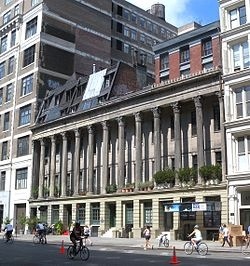 Developer Seth Greer developed Colonnade Row at 7th and Lafayette and just off Astor Place in 1833. This magnificent building contained nine Greek Revival townhouses built of marble and with a broad three storey colonnade and corinthian columns. Greer developed the complex “on spec” to attract wealthy New Yorkers. Pundits of the day expressed doubt that they would sell because of their location. However, soon people like Astor and Cornelius Vanderbilt purchased units, development took off and the East Village became the place to live for wealthy New Yorkers. Authors Washington Irving, William Makepeace Thackeray and Charles Dickens and Franklin Delano Roosevelt’s merchant father all lived here for a period. Today only four of the townhouses remain, the others having fallen to more recent development. There is some controversy here about the state of these buildings, being in need of significant restoration to return them to the glory they deserve.
When John Jacob Astor III died in 1849, he left $400,000 to develop a library across the street from Colonnade Row to hold his family’s extensive collection. The Astor Library was completed in 1854 and became the first, free-access libraries in New York City. It was so popular that two additions were made to the building by 1881. In 1905, the Astor collection was joined with two others to become the New York Public Library.
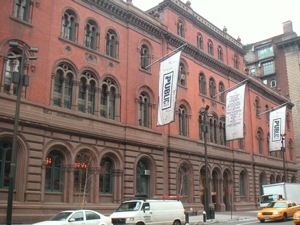 This beautiful red brick and brownstone building was purchased by the City in 1967 and converted to a live theatre venue with six stages. It has been beautifully renovated and is operated as The PublicTheatre. Stages in this theatre have premiered many alternative and mainstream plays, including Hair and A Chorus Line .
The Public Theater has earned a name as an incubator of theatre. Its productions have won 42 Tony Awards, 151 Obies, 41 Drama Desk Awards and four Pulitzer Prizes. Fifty-four Public Theater productions have moved to Broadway, including That Championship Season; A Chorus Line; The Pirates of Penzance; The Tempest; the revival of HAIR; Bloody Bloody Andrew Jackson; The Merchant of Venice and The Normal Heart.
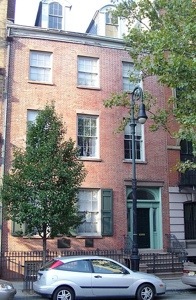 If you walk up Lafayette and keep right onto Stuyvesant Street at Astor Place you will find a beautiful set of Federal-style brownstone residential buildings anchored at one end by the Stuyvesant-Fish House built in 1803. The house was one of five owned by the Stuyvesant family on their private lane and was built by Peter Stuyvesant, the great-grandson of Petrus Stuyvesant as a wedding present to his daughter, Elizabeth, and his son-in-law, Nicholas Fish. This was the birthplace of Hamilton Fish, a future New York State Governor, US Senator and the 26th US Secretary of State (1869 – 77) under President Ulysses Grant. Fish has been considered one of the best Secretaries of State in the United States’ history; known for his judiciousness and reform efforts. It was one of five houses owned by the family on their private lane.
 At the end of the block is St Mark’s in the Bowery Episcopal Church built in 1799. This is the second church on the site, the first having been built in 1660 by the Stuyvesant family. There is a cemetery In the yard adjoining St. Mark’s which hold the remains of Petrus Stuyvesant (1672); Nicholas Fish, a general in the revolutionary war; John Colt, brother of the maker of the Colt revolver; and Daniel M. Tompkins, former US Vice President under President John Munro.
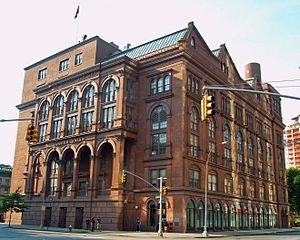 On the corner of 3rd Avenue and Astor Place is Cooper’s Union. Coopers Union was created in 1859 by Peter Cooper, a self educated industrialist who built the first steam locomotive in the US, made the first steel rails and was a partner in the first transatlantic cable venture. Unable to afford school, Cooper committed his wealth to this educational institution that specializes in design, architecture and engineering. From its beginning and continuing today, the school provides free tuition to those who qualify for admission.
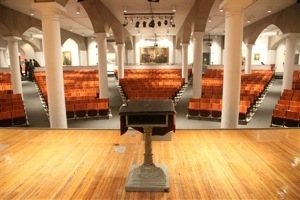 In the basement of the Union is the Great Hall. This grand meeting place – the largest in New York in its day – was inaugurated by Mark Twain in 1859 and made famous by the “Right Makes Might” speech of Abraham Lincoln (1860) which is credited with winning him the US Presidency.
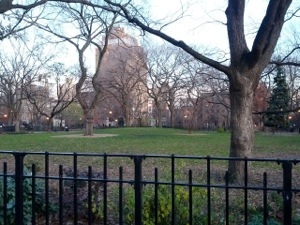 Two blocks further east is Tompkins Square, created in 1874 as a remembrance to Daniel Tompkins, and now a formal English Garden. This park has been the location of many significant events in New York’s history. In 1857, immigrants protesting unemployment and food shortages were attacked by police. In 1863, the deadly Draft Riots occurred in the park. In January 1874, the Tompkins Square Riot occurred in the park when police crushed a demonstration involving thousands of workers marking an unprecedented era of labor conflict and violence. In 1877, 5,000 people fought with the National Guard when they amassed to hear Communist revolutionary speeches.
More recently, Tompkins Square was also the location of the first recorded Hari Krishna chanting event outside India. And in August 1988, a riot erupted in the park when police attempted to clear the park of homeless people; 44 people were injured. And does anyone remember Daniel Rakowitz? He shocked the neighbourhood in 1989 when he murdered Monika Beerle, dismembered her, made a soup out of her body and served it to the homeless in the park.
From its reputation as a symbol of the city’s increase social problems, Tompkins Square Park has become a beautiful neighbourhood park full of towering elm trees, formal gardens and parents with kids and dogs.
The East Village flourished for many years but by the end of the 19th century, the area had gone from expensive elegance to industrialization and declined to one of the poorest neighbourhoods in the City. As the wealthy moved uptown to newer neighbourhoods, this area became the first landing place for thousands of Irish, Jewish, German, Ukrainians and Puerto Rican immigrants. And for many years, the area along the Bowery had the distinction of being New York’s skid row, rife with unemployment, drugs, gangs and prostitution. Do you remember the Bowery Boys? These were the “bums” who made this area home.
Today, the East Village is an area going through yet another transition. From Broadway to 2nd Avenue, many of the older buildings have been updated and many replaced with high-end condos.
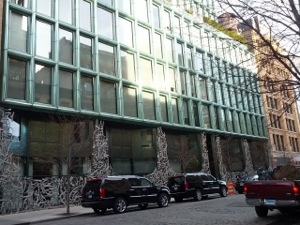 One of the most extreme examples is at 40 Bond Street, a wide cobblestoned street, lined with a mix of buildings from the 1800s and replacements developed over the last 5 years. In front of this ultra-modern building, drivers line the curb in their Cadillac Escalades awaiting the pleasure of their employers who live in the very swank building. Condos in the area are often priced in the millions.
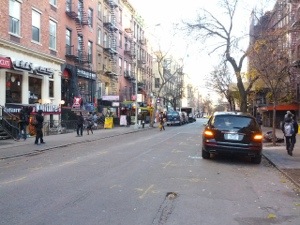
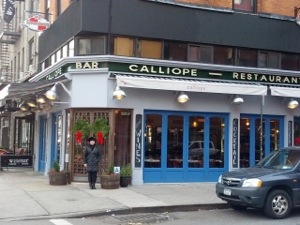 Fortunately much of the neighbourhood retains its bohemian character. Narrow, tree lined streets with brownstone walkups are lined with small shops, tattoo parlours, experimental music clubs and theatres. There are restaurants to meet every taste and pocketbook. Even one named after Penny!
Many of the larger buildings are owned by New York University that has spread across Broadway from Greenwich Village so there are a lot of students in the area. The entire area has a bit of an “edge” to it, especially along the sourthern edge at Houston Street but it was well worth the two afternoons we spent wandering around. One of the most interesting we have visited.
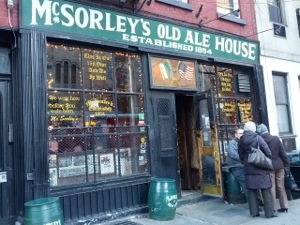 But one of the neatest places in the area is McSorleys Old Ale House on East 7th Avenue.
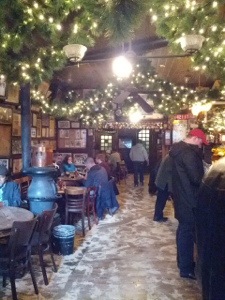 This saloon was opened in 1854 as a men only saloon and has continuously operated ever since, even through Prohibition. The exterior and interior of the building are pretty much the way it was 170 years ago with sawdust covered wood floors, a potbellied wood stove in the middle of the room and walls adorned with memorabilia including period newspaper articles, pictures and an original wanted poster for John Wilkes Booth, Abraham Lincoln’s assassin.
And women were not welcomed at McSorley’s until federal law forced it in 1970!
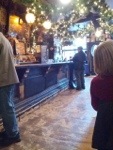
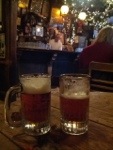 They only serve their own light or dark ale – two glasses for $5. A remarkable place that was mostly full at 3:30 in the afternoon when we stopped for a bowl of homemade chili. One of the uniquely New York places that can’t be missed.
 Penny & Ken
 Casa New York