In the first two chapters of our Boston Blog we talked about our trip around the City, through the parks, open spaces and neighbourhoods and then about our trip down memory lane with the Ride of Paul Revere and the origins of the American Revolution. In this blog we want to talk briefly about the third leg of our journey, to the academic heartland of Massachusetts, Harvard University.
Across the Charles River from Boston is Cambridge, Massachusetts, Cambridge was named in honor of the University of Cambridge in England, an important center of the Puritan theology embraced by the town’s founders. Cambridge is home to two of the world’s most prominent universities, Harvard University and the Massachusetts Institute of Technology. In 2010, the city’s population was 105,162, and added to Boston’s population of 617,600 the two cities are about the same size as the City of Vancouver.
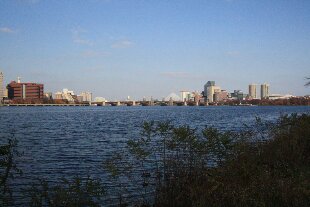 Cambridge is a college town – being the home of two of the three top universities in the world, the Massachusetts institute of Technology and Harvard – a lot entrepreneurial – being the home of a significant campus of established and start-up technology and biotechnology companies which feed off the universities – and a lot residential. When you cross the Commonwealth Bridge from Boston, you are struck by the massive buildings housing these high-tech and bio-tech tenants, many having been incubated at the universities and others drawn there to access the research and other resources they offer. We only had a short time to visit MIT but were impressed by the imposing scale and activity of the campus. We were also impressed that the subway system stops right at both campuses.
We did get to spend a few hours on the grounds at Harvard and in the neighbourhood around it. The experience was as magical as the legendary status that the university would suggest.
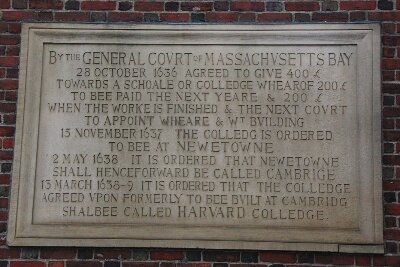 Harvard (officially The President and Fellows of Harvard College) is the first corporation chartered in what is now the United States, having been constituted in 1636 by the Massachusetts legislature and making it the oldest institution of higher learning in the country. We found this plaque on the wall at the entrance that details the origins of the university by the Commonwealth of Massachusetts.
Harvard is the U.S. university that is both closest to the British model of university education, yet distinctly American in identity and outlook. It is comprised of 10 academic units (Arts and Science, Education, Engineering, Graduate Studies, Government, Continuing Education, Dental, Divinity, Medicine and Law ) and the Radcliffe Institute of Advanced Studies. Harvard began as an all boys school and Radcliffe was the female counterpart until the schools amalgamated in the 1960s. The Kennedy School of Public Administration sits along the Charles River on the southern edge of the campus.
About 6% of the applications for admission are successful each year. Successful applicants are in the top 5% of high school graduation and SAT and ACT scores must be in the highest 25%. There are about 21,000 students and 2,100 faculty at the university at any one time.
Annual tuition is based on income and significant financial aid is provided to every student. Qualifying students from families earning less than $65,000 annually pay nothing to attend while fees, maxing out at 10% of income, are paid for incomes above $65,000. Stated tuition in 2012/13 was $37,600 and room and board was $13,600. In this current year, the university provided $166 million in tuition assistance to students. This is possible because of the $32 billion endowment held by the university. It is interesting to note that the undergraduate student body numbers about 1/3 of the total enrollment at 6,675. Of these, 97% are expected to graduate the 6 year program. The genders are represented equally among the student population. Out-of-state students represent about 85% and about 20% are international student. 97% of students live on campus in the various residences that surround the Yard.
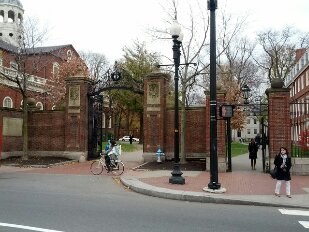 We entered the campus through Johnston Gate which is considered to be the main entrance to the university off Massachusetts Boulevard. Not very ceremonial but remember this entrance was created when horse and carriage trade was the primary means of transportation.
The campus developed around the Old Harvard Yard, a beautiful open quadrangle surrounded by historical buildings still in use today. The Yard is filled with beautiful red oak trees which provide a natural canopy. Amazing that we may have rubbed shoulders with a future US President or states-person as we walked the paths Harvard certainly has its share of notable graduates. Recognize any of these?
- Ashley Judd (2010) graduated from the Kennedy School of Public Adminstration
- Barak Obama (1991) was the first African American editor of the Harvard Law review and his wife Michelle (Law, 1988)
- Yo-Yo Ma (1976) won an honourary doctorate in music
- George W. Bush (1975) earned an MBA after earning a bachelor’s degree from Yale.
- Ben Bernanke (1975) earned a business degree
- Benazir Bhutto (1973) Pakistan’s first female prime minister
- Tommy Lee Jones (1969) and his room mate Al Gore (1969) who was a politician even at Harvard: a government concentrator, Freshman Council chairman, and a member of the Harvard Undergraduate Council and Young Democrats.
- John Lithgow (1967) where participated in everything from opera to ballet to directing.
- Jack Lemmon (1947) who served as vice president of the Dramatic Club in 1944, having starred in The Playboy of the Western World.
- Norman Mailer (1943) the Pulitzer Prize-winning author who concentrated in engineering sciences while at Harvard.
- David Rockefeller (1936) of the New York Rockefeller family eventually became chief executive officer of Chase Manhattan Bank
- Archibald Cox (1934) who became the special prosecutor during the Watergate investigations.
- Helen Keller (1904 Radcliffe) was the first deaf and blind person to earn a Bachelor of Arts degree.
- Franklin D. Roosevelt (1903) who was Editor-in-Chief of The Crimson and lived in Adams House while his cousin Theodore Roosevelt (1880) was inaugurated president of the U.S.
- Ralph Waldo Emerson (1821) who entered Harvard College at the tender age of 14.
- John Quincy Adams (1787 and 1790) who turned his education and time as a flutist in the college band into the Presidency of the United States.
An impressive list of graduates to be sure.

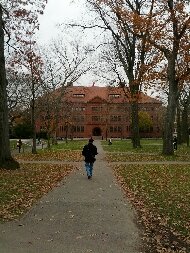
Johnston Gate takes you directly into the Old Harvard Yard, the original campus area. The buildings on the Old Yard and adjacent areas are arranged in a series of quadrangles. Many of the buildings on the Yard date back to the 1700 and 1800s and are for both residential and academic uses. Massachusetts Hall on the west side of the Yard was built in 1720.
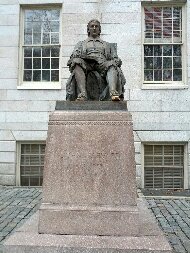 A statue of John Harvard, the original benefactor of the university sits prominently in Harvard Yard. Legend has it that if you want to be admitted to Harvard, you need to rub the toe of his shoe. Hundreds trek there annually and, while the rest of the bronze statue is tarnished with the weather, the toe of his shoe glistens brightly in the sunshine.
 A typical residence building at the north end of the Yard, Holworthy Hall, was built in 1812 to honor the largest donor of the day who contributed £1,000. In a mirror quadrangle to the east of the Old Yard are the main Weidner Library and the Harvard Memorial Church.

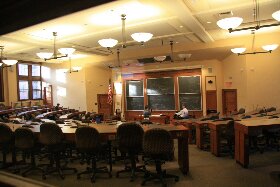
 North of Cambridge Boulevard – the main thoroughfare running through the City – is the Science building and the magnificent Faculty of Law (Austen Building, 1883) and (Langdell) Law Library. Amazing to think of the famous law graduates that have passed through these halls and lecture theatres. As we wandered the buildings we joined groups of prospective students (some with their parents) being toured around the campus by senior students. We picked up a few tidbits: For example your chances of getting a private room increase if you ask for specific dorms.

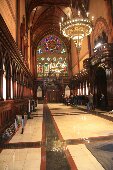 Memorial Hall (1878) is a magnificent church-like building with soaring wood vaulted ceilings and stained glass. The building which contains a massive meeting room/dining hall, a large foyer hall commemorating Harvard grads who have perished protecting the country and a large performance and music theatre. This building is reminiscent of a church, with stained glass and soaring arches. The building is so big, it was hard to get a clear picture.
It is hard to comprehend the size of the campus. It is so large and so integrated into the community that is would take a much more time to find and visit than we had. If you go, download the interactive campus map from the Harvard website along with the self guided narrated tour you can put on your smartphone or tablet. Or visit the visitor centre and get a personalized tour from a senior student.
Adjacent to the main part of the campus is Harvard Square, a commercial/retail/ restaurant area full of great little shops that support the campus. We went into the bookstore, which like many other university bookstores in the US is run by Barnes & Noble. They have a computer controlled book publisher/binder that can take any electronic file or old textbook and duplicate it and bind it in minutes. And we of course visited the Harvard “equipment” store to pick up some trinkets.
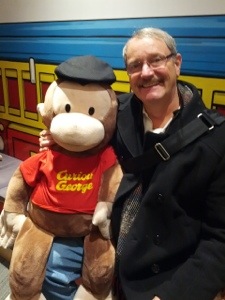 Finally we stopped to visit Curious George where I made a new friend who obviously has great taste in hats. George advised us to take in all that Boston and Harvard have to offer and to buy one of his books for our grand daughter. We took his advise.
If you ever go to Boston, you should plan on a visit to Harvard. It is one of the most impressive places you can imagine. We felt smarter just having been there. And on the day we left Boston, Harvard beat Yale 34-24 in the annual classic football game.
 Penny & Ken
 Casa New York