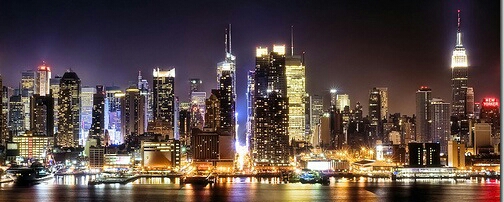
We began Boston 1 with the opening verse from Longfellow’s The Ride of Paul Revere which relates the most publicly recognized event of the American fight for independence. Boston is recognized as the home of the American Revolution and the City is full of reminders of the important people, places and events American history. I expect that has to do with celebrating their revolutionary past, something we don’t get to enjoy in Canada, perhaps to our detriment. The historical significance of the area is reflected everywhere, and Americans and others who come here have the opportunity to re-live this history.
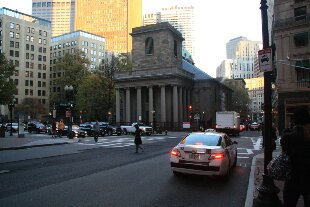 The history is everywhere. A short block from our hotel is Kings Chapel founded in 1686. The current building was constructed in 1749 and Paul Revere cast the the bell for the church steeple in 1816 at his Revere & Sons foundry: “the sweetest sounding bell I have I have ever cast”.
On the same site is the Kings Chapel Cemetery, the oldest in Boston with headstones dating from the 1600s. Mary Chilton, the first European woman off the Mayflower is buried here along with former British military and American Revolution patriots, the first governor of Massachusetts and even a pirate or two.
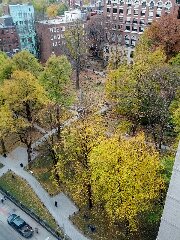
Ben Franklin’s parents, Paul Revere and three signatories of the Declaration of Independence. – John Hancock, Samuel Adams and Robert Trent Paine – are buried just down the block in the Granery Burial Ground which was across the street from our hotel. 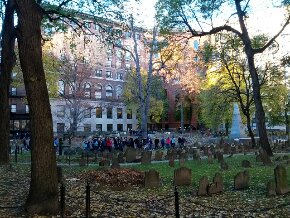 There is a daily pilgrimage through these burial grounds from sunrise to dark.
Looking toward the North End from our hotel room, we had a clear view of the Old North Church where those famous lanterns were hung in April 1775 to signal the movement of British troops to Lexington and Concord and the opening battles of the American Revolutionary War.
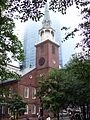 Just a block down the hill from Kings Chapel is the Old South Meeting House. This building was constructed in 1729 by a breakaway congregation from the First Church of Boston.
  This was a regular “hangout” for the revolutionary colonists as they conspired and spoke out against British rule. It was at this building on December 16, 1773, during a debate on British taxation that Samuel Adams riled up 5,000 patriot colonists resulting in the assault on British ships in the harbour and where 342 cases of tea was thrown into Boston Harbour as a protest. History’s most famous tea party! Benjamin Franklin was baptised in this building.
In 1872 the Great Boston Fire swept through the area and almost destroyed the church. The congregation made the decision to move to the newer area of Back Bay where it continues to worship in the New South Church, returning for an annual commemoration of the building’s role in the revolution.
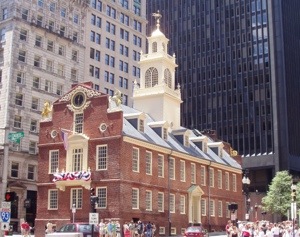 Down the street is the Old State House (1713). The American Revolution took root in this building when James Otis delivered a fiery speech against the Writs of Assistance passed by the British Crown which taxed imports to the colonies. In 1768, the local legislature refused to rescind their call for united resistance against this British taxation of the colony, leading to the occupation of the city by British troops.
In March 1770, British troops fired on protestors throwing snowballs and rocks at the building, killing five in what has become known as the Boston Massacre. And in 1776, the Declaration of Independence was first read to the people of Boston from the exterior balcony. After the Treaty of Paris was signed in 1783 giving the 13 colonies independence, this building housed the Commonwealth of Massachusetts government. You can feel the history here, it oozes from the buildings; it is in the air.
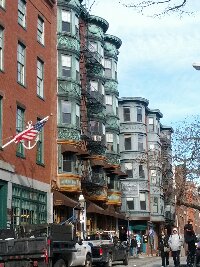 Beyond downtown is the North End, which was the site of the original settlement along Boston harbour. While most of the original buildings were replaced in the 1800s, there are many landmarks from the early development. They are built of wood with red brick facing and they border narrow cobblestone streets.
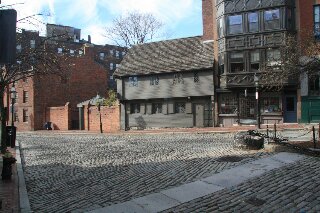 Paul Revere and other notable patriots were born and raised in this neighbourhood. The house Revere bought in 1760 and where he and his two wives and 16 children (11 survived) lived for 30 years still stands at 19 North Square.
 The house is only a short walk from the Old North Church built in 1723 and the oldest active church still standing in Boston. You can almost feel the designers of the American Revolution on these streets today, plotting against the British in the local pubs. The church sits on Salem Street, off Hanover Street through Paul Revere Mall which commemorates the primary participants in the Revolutionary War. The church still has a large Episcopalian congregation and observes regular services. The interior of the church is a remarkable reminder of its British heritage with a strong Georgian style (similar to many buildings around Boston) and its strong ties to the Church of England. Note the pewboxes lining the nave rather than the more modern benches and the height of the lectern above the congregation.
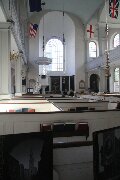 From the church bell tower, church sexton Robert Newman and Captain John Pulling hung two lanterns – “two if by sea” – as a warning to Paul Revere and William Dawes waiting across the Charles River in Charlestown, about the movements of the British troops sent to seize arms and arrest the patriot leaders. These riders – and a number of backups in case they were arrested by the British – warned Samuel Adams and John Hancock in Lexington of the approaching British troops under the command of Lieutenant Colonel Frances Smith.
At dawn on April 19th, the British and patriot troops fought the first battle of the American Revolutionary War on the green in Lexington. The patriots were overwhelmed but Adams and Hancock had fled toward Concord. The British marched on to Concord where 500 patriot troops were waiting and repulsed the much stronger British forces at the North Bridge. The British released their patriot prisoners and retreated to Boston, suffering further losses through guerilla attacks along the road.
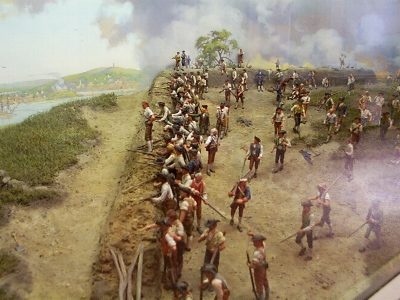 From the Old North Church tower, the monument to the Battle of Bunker Hill in Charlestown is clearly visible. This monument is a tribute to the this third major battle of the war, on June 17, 1775. However, it is an interesting fact that the monument is actually on the slightly higher adjacent Breed’s Hill. Although he was ordered to establish an offensive position on Bunker Hill from which the patriots could bombard the City of Boston, Colonel William Prescott determined that this position would be vulnerable from the higher Breed’s Hill and moved the patriot installation there. The Battle of Bunker Hill, on June 17, 1775, the first major battle after Lexington and Concord, was the first patriot – British encounter where the revolutionary army held its own through two British assaults. This buoyed the Americans even though on the third assault by the British, the Americans were overrun.
Today, the sections of the North End closest to downtown Boston have become “Little Italy”, the home to over 200 Italian restaurants. Walking along Hanover and Salem Streets, and the smaller ones that connect them, you can find every kind of Italian fare you can imagine from large tourist oriented eateries to smaller (30 seat) family style restaurants. We ate at a great little restaurant in the heart of Little Italy called Pagliuca’s Ristorante Italian off Hanover Street. It was a family affair and the service and food was great. We just need to go back and visit Michael’s Bakery for dessert. For a picture of our fabulous meal, check out my post on Facebook.
If you just go to Boston for the history, you will not be disappointed. There are so many memorials to those events and people who forged the US independence and defended individual rights in the American Civil War 100 years later. If you do a little reading before you go, walking the streets and visiting the landmarks will be even more meaningful. But don’t go just for the history, it is a beautiful City and I expect in spring or early fall it is even more beautiful than we saw it.
 Penny & Ken
 Casa New York