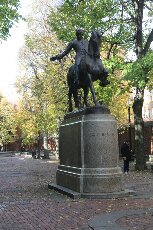
 Of the midnight ride of Paul Revere,
On the eighteenth of April, in Seventy-five;
Hardly a man is now alive,
Who remembers that famous day and year.
The ride of Paul Revere has become the symbol of the resolve of American patriots leading to the American Revolutionary War and although the 1860 depiction of the Ride of Paul Revere by Henry Woodsworth Longfellow employs a a little poetic licence, you can’t help but be caught up in the real history that lives here and frames the story of American independence.
 We spent four days in Boston last week and there is so much to comment on it couldn’t be managed in a single blog. So consider this: BOSTON 1. Bostons 2 and 3 will follow.
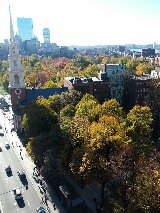
We stayed at the Klimpton Nine-Zero Hotel on Tremont Street; south east side of Beacon Hill just above the business district. Our room looked west over Boston Common, Back Bay and the Charles River and northeast toward the famous North End. Most of Boston was within an easy walk and Cambridge – the City, not the university – was just across the Charles River by subway.
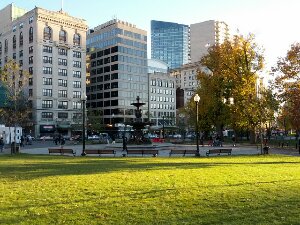
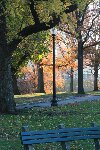
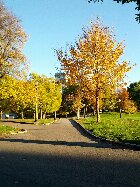
At the centre of the City is Boston Common. This is the oldest public park in North America, dating from 1635 when the reclusive Anglican minister William Blackstone sold his property to the townspeople of Boston. Each household was assessed six shillings for the 44 acres of open land which was held “in common” by all residents.
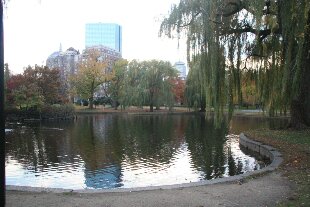

The Common was first used as a common pasture and later became a training ground for the British Army, a place to hang pirates and witches or publically punish criminals in “stocks”. It has also served – and does today – as a place for public oratory and discourse. Today the park and adjacent Public Gardens serve as an quiet open space in the middle of the City. At Frog Pond, they were installing the much anticipated outside skating rink. The Common is much smaller than Central Park but as important to Bostonians.
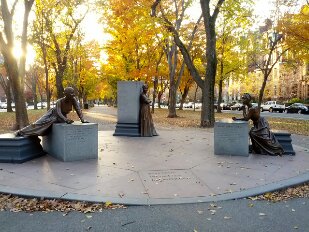
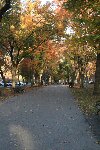
Boston has many other beautiful parks and open spaces. The “Emerald Necklace”, a series of mostly linear parks leading west from Boston Common was designed in the 1880s by Fredrick Olmstead of Central Park fame. The “greenway” down Commonwealth Avenue west from the Public Gardens is the beginning of this chain of interconnected parks and greenways. The median conntects with the Back Bay Fens just a block from Fenway Park, home of the Boston Red Sox. The Fens are a series of ponds and marshes and provided the inspiration for Fenway – the way around the fens. The baseball stadium, not far from the commercial and residential areas of Bostoiin, much like at Wrigley Field in Chicago, is now 100 years old.The City has also taken the opporunity to develop public parks and open spaces along much of it inner city subway lines.
Speaking of subways, did you know that Boston had the first subway line in the US? Its first line opened in 1897, one year before New York. The developers designed the system to us steam engines but quickly realized that steam trains would not work well underground without ventilation. As a result, the trains were horse-drawn.

Above the Commons on the top of Beacon Hill is the State Legislature which was built in 1798. The building is topped with a large dome, originally made of wood and later overlaid with copper by Paul Revere – who was actually better known here for his skill as a goldsmith. Revere’s roof remains today but under gold leaf.
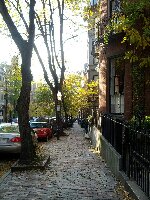
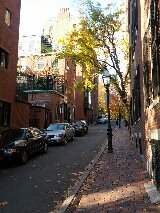
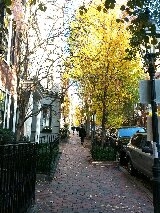 On the west side of Beacon Hill is the prettiest and priciest residential area in Boston. The 18th and 19th century red brick houses line narrow cobblestone streets lit with gas lamps. Most of these buildings have been updated into beautiful homes and apartments.
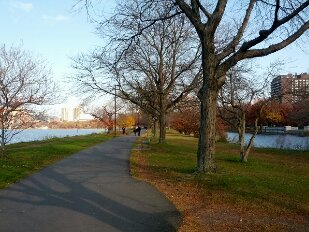 West from Beacon Hill and the Common is Back Bay, a predominantly residential area of 1800s buildings built on land reclaimed from mudflats on the Charles River. Beacon Hill is lower today because soil from the hill was moved down the hill to create fill this area.
Along the riverfront a public park stretches from the Commonwealth Bridge to the Harvard athletic complex on the south side of the river. I wondered why the Charles River isn’t affected by the tide and discovered that the river is dammed to maintain the water level sufficiently high to protect the thousands of piles on which Back Bay buildings are built. A set of locks allows passage of pleasure boats to the Boston Harbour.
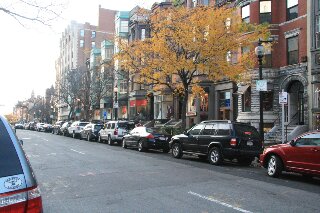 Back Bay is also home to the trendy Newbury Street where the lower levels of many of older houses have been converted to fashionable retail outlets. One block south of Newbury is the more established retail area along Boylston and Huntington streets.
The centre of this area is Copely Square. At one end of the square is the historic Trinity Church (originally founded in 1733) building constructed in 1872.
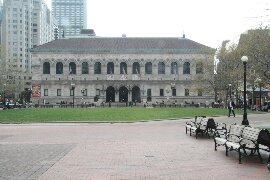
 At the other end of the square is the Boston Public Library established in 1854. This was the first publicly supported municipal library in the United States, the first large library open to the public in the United States, and the first public library to allow people to borrow books and other materials and take them home to read and use. The entrance to the library and some of original rooms include beautiful marble work and expansive murals and the main reading room with high vaulted windows and green-shade lamps is beautiful. Today this massive central library manages over 23.5 million books, periodicals, etc.

 Saturday morning, we walked into an area known as the South End. In the 1980s, this was an area most Bostonians avoided because it was unsafe and remote, cut off from the city by the Massechusetts Turnpike. However, this was an area where many upper scale Bostonians lived in the 1800s – George Washington’s doctor lived on Union Street – and there are street after tree-lined street of red-brick, bow-front townhouses with ornate entrances and stoops.
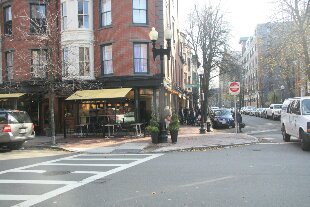 Since the 1990s, as housing got more expensive in other areas of the City, the South End quickly gentrified and many of the buildings were renovated. Today it is a unique neighbourhood and It’s not hard to see why young, upscale families and the nouvea riche are drawn here. Many streets have beautiful median parks and there is a renewed cultural community and some of Boston’s best restaurants, design stores and boutiques. And all of this has happened without losing the historical character of the neighbourhood. The food and retail shops are scattered along Tremont, Shawmut and Washington streets. We had a great morning wandering up and down the side streets off Tremont and watching the upper middle class folks walk their dogs and kids – all with a Starbucks in hand – shop and visit the local eateries. On Saturday, some homeowners were busy decorating their homes for Christmas. Hard to believe on such a beautiful day, that Christmas is not far off.
Two other things that were interesting to me about Boston:
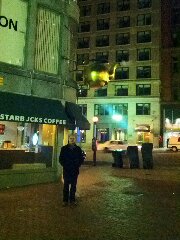 Mounted outside the store at Tremont and Court is a large copper tea kettle with steam coming from the spout. This pot was the official trademark of the Oriental Tea Company, one of the first registered corporate marks in the US. On January 1st 1875, a contest was held to guess the capacity of the kettle, and Boston’s Sealer of Weights & Measures officially measured it. A total of 13,000 guesses were submitted, that were quickly organized and sorted. At the close of the contest, more than 10,000 spectators filled the square. Eight boys and a tall man had concealed themselves inside the kettle and appeared before measuring started, building excitement for the event. It took more than an hour to fill the pot to capacity; two hundred and twenty seven gallons, two quarts, one pint, and three gills. Eight people were declared winners and received one-eighth of a chest of tea, or about 5 pounds each. The name of the store hosting the pot today? Starbucks.
The second interesting thing is that it is home to the building designated as one of the worst designed in the US by the American Architectural Institute. It is an imposing hunk of concrete with slits windows and massive columns surrounded by acres of the most desolate brickyard you can imagine. Nothing pleasing or attractive about it. Completely devoid of vegetation. Some bad corporate citizen? No the building is Boston City Hall. Hard to beleive in a city with the history and beauty of Boston that such a thing could happen.
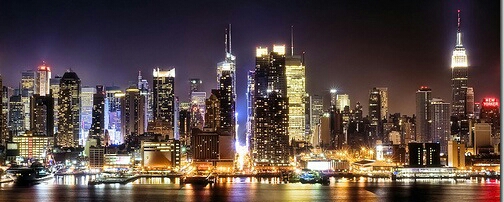
Boston is not New York by any means. It is smaller in size and population and even though the history of both cities date to the earliest years of America, Boston has much more of the feel of a City from which the spirit of independence was born. A beautiful place which reminded us more of Vancouver and well worth an extended visit. But wait until the Red Sox are playing at Fenway Park, then go to see the Green Monster.
 Penny & Ken
 Casa New York