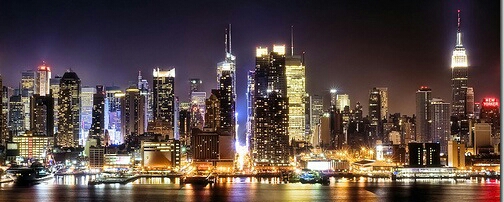
In 1858, Fredrick Law Olmstead and Calver Vaux set their sites on an unpromising piece of land in upper New York to create what has become the landmark in Manhattan. No picture of New York is complete without at least a glimpse of the infamous Central Park. In the 1840s this area was an area full of quarries mining granite, pig farms, swampland and squatters tents. Today, it is 850 acres of scenic hills, lakes, and lush meadows, with more than 500,000 trees in formal and natural plantings, playgrounds, ball fields, skating rinks and innumerable other activities. Central Park is the “backyard” of many New Yorkers who flock to the park on weekends to get away from the city.
The interesting thing about Central Park is that after the design was completed, Olmstead and Vaux were unhappy with some aspects of the design. When commissioned to design a second major park, Prospect Park in Brooklyn in 1865, they set out to correct them.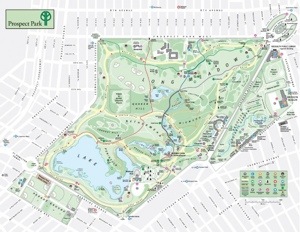
The site of this new park had an important history. Brooklyn had its beginnings as the Dutch colony of Breuckelen in 1646. Funny how a lot of Dutch names were converted to English after the Duke of York took over in 1664.
A hundred years later, in 1776, the area became the site of the first major conflict of the Revolutionary War. In late August 1776, the Continental Army under George Washington fortified passes along a section of Flatbush Avenue that now serves as the Park’s Drive. As British and Hessian soldiers approached from the south, the Americans fought in vain to hold them back at Battle Pass. Although the Continental Army lost the battle, they held the British back long enough for Washington’s forces to make a moonlit escape from Brooklyn Heights to New Jersey. This battle is commemorated by plaques and statues along the northern edge of the park where Washingtion made his stand.
We discovered similar areas within Central Park, small hills on which defences were established to defend against those who threatened the colonization and then growth of America. One small hill at the north end of the park contained fortifications used by the Americans in the War of 1812, although I don’t think anyone showed up at Central Park. But I digress – back to Brooklyn.
The original park design was for a rural retreat for a growing Brooklyn and as such it had only minor buildings. However, by the turn of the century it was becoming more of a civic space – a place to erect busts of famous citizens and build imposing neoclassical structures. During the next 30 years, the renowned architectural firm of McKim, Mead, and White was hired to formalize the park’s major entrances with columns and statuary. The Boathouse, Tennis House, Picnic House and a Model Yacht Club were constructed, as were several bridges and comfort stations. In 1912, the carousel was added.
 Today, a 20 minute subway ride will take you to its main gate – the Grand Army Plaza. The plaza is a huge oval sitting in the middle of Flatbush Avenue and containing the Soldiers’ and Sailors’ Arch comemorating the Union soldiers who died in the Civil War. Vaguely reminiscent of the Arc de Triumphe.
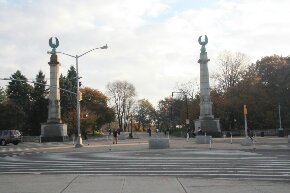
Proceeding past the arch, you proceed through the very formal entrance to Prospect Park, a 580 acre parcel in the middle of the residential area of Brooklyn, containing woodlands – the last remaining virgin forest in Brooklyn – meadows, bluffs and ponds. Located on the highest land in Brooklyn the park entrance also provides view out toward the Atlantic Ocean.
The main feature of Prospect Park is Long Meadow, a broad expanse of open grass space of variable width that extends from the entrance to the bottom of the park more than a mile away.
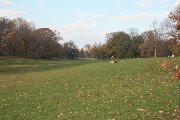
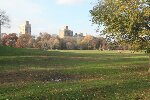
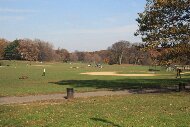
The meadow cascades down over hilly ground, working its way through a natural depression and bordered by forest and wooded areas. Interspersed along the meadow are playing fields and ball parks. On Monday when we were there – a partial holiday for Veterans’ Day – the meadow was full of Brooklynites enjoying the balmy weather, flying kites, playing football and croquet or just walking the kids and/or the dog. At the bottom of the park is Prospect Lake, about triple the size of Lost Lagoon and filled with ducks, geese and swans. Around the lake there were kids and adults fishing (barbless hooks, catch and release). Three horses carried their riders along the dedicated riding trail.
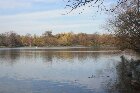
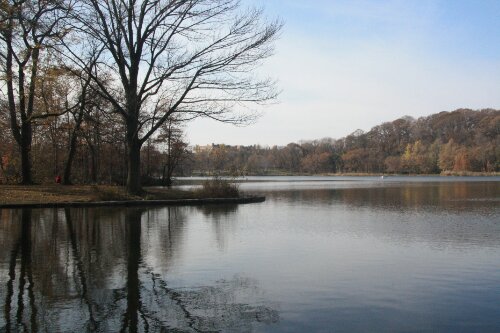
Throughout the park are unique little areas for relaxation and organized sport. And like Central Park, there are no vehicles allowed on the roads which are marked for pedestrians and bicycles. Only park vehicles are allowed. As we walked around the park, hundreds of people of all ages and abilities, walked, ran and rode their bikes. In a beautiful area at the north end of the lake is the Boathouse, which houses a small cafe and the programs run by the Audobon Society. There are classical gardens, rocky outcroppings and small streams running throughout. And of course, typical of larger New York parks, there is the a children’s zoo and carousel.
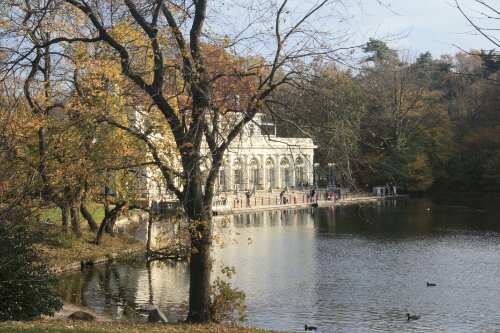
One of the very sad parts of our visit was to witness the damage that Hurricane Sandy left in the Park. Hundreds of trees were blown over at their roots or had major limbs broken off like they were match sticks. Beautiful oaks and elms and maples, many 4 feet in diameter at the base and some of them older than the park are down or damaged throughout the park. It is a bit like the damage to Stanley Park in the wind storm a few years ago, except the damage is more selective and widespread around the park. Fortunately the forests in the park are significant enough that they will recover.
Bordering the Prospect Park is the Brooklyn Public Library and the Brooklyn Museum which is one of the great museums of the new world and behind them the Brooklyn Botanical Garden. The institutions were closed on Monday for Veterans’s Day but we did get an hour to walk through much of the BBG. Even though it was off season, it was a very peaceful and tranquil place in the middle of an urban jungle. Like Central Park, once entered, these places in Brooklyn take you to a completely different world.
We had a great day walking through this second great park in New York, one that is unknown to most who visit here.
 Penny & Ken
 Casa New York